
What is Addison’s disease?
Addison’s disease is potentially a life threatening condition in which the outer layer of the adrenal glands (the adrenal cortex) insidiously slows production of corticosteroids hormones. The disease usually occurs when the adrenal cortex is damaged or destroyed as a result of autoimmune disorder, in which immune system mistakenly attacks the adrenal glands. In very rare cases tuberculosis can cause Addison’s disease.
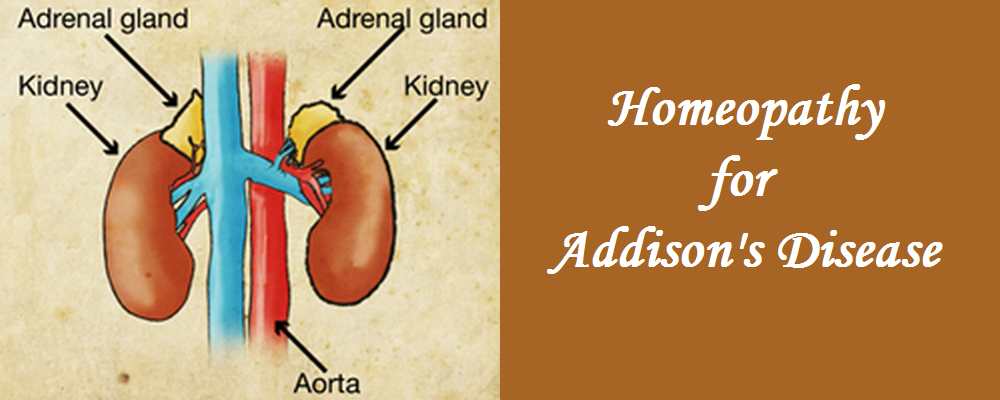
Adrenal glands are located just above the kidneys; they are part of a system known as endocrine system. The outer part of adrenal gland or cortex is responsible for the production for making three main hormones – mineralo corticoid, Glucocorticoid, and sex hormones. Glucocorticoids such as cortisol regulates the energy need of our body, stress response, and immune function. Mineralocorticoid, such as Aldosterone, regulates the sodium and potassium balance in our body. Mineralo corticoids and Glucocorticoids also help in the regulation or control blood pressure. Sex hormones such as estrogen and testosterone are responsible for the development of sexual characters in the body. In Addison’s disease, damage to adrenal cortex causes decrease or insufficient production of these hormones, particularly cortisol and Aldosterone.
Sign and symptoms of Addison’s disease
Significant Weight loss and coppery skin tone are the main characteristic feature of Addison’s disease, all patients with this disease experiences this before diagnosis; the skin color change is the key diagnostic indicator in advanced cases of this disease.
Sign and symptoms mainly involve
- Extreme fatigue
- Significant appetite loss
- Malaise
- Depression
- Nausea
- Vomiting
- Diarrhea
- Muscular weakness
- Dizziness
- Anemia
- Concentration difficult
- Low blood pressure or hypotension
- Low blood sugar or hypoglycemia
- Thyroid disorders
- Mood changeability
- Enhanced levels of blood urea nitrogen
- Salt craving
Homeopathic treatment of Addison’s disease
Homeopathy is one of the most popular holistic systems of medicine. The selection of remedy is based upon the theory of individualization and symptoms similarity by using holistic approach. This is the only way through which a state of complete health can be regained by removing all the sign and symptoms from which the patient is suffering. The aim of homeopathy is not only to treat Addison’s disease but to address its underlying cause and individual susceptibility. As far as therapeutic medication is concerned, several remedies are available to treat Addison’s disease that can be selected on the basis of cause, sensations and modalities of the complaints. For individualized remedy selection and treatment, the patient should consult a qualified homeopathic doctor in person. There are following remedies which are helpful in the treatment of Addison’s disease:
Adrenalin, arsenic album, phosphorous, Calcaria Ars, Iodum, Sepia, Silicea, Natrum Mur, Calcaria Carb, Argentum Nitricum, Sulphur, Belladonna, Tuberculinum, Nitric Acid, Kali Carb, Ars Iod and few other remedies.
#Arsenicum [Ars]
This is the most homoeopathic of all remedies to this disease. Both the disease and drug have nerve depression, gastric irritation, general debility, feeble heart action and tendency to vomit. The skin symptoms have also a curious similarity; both the burning and the discoloration have been found in several cases of poisoning by Arsenic.
The disease, though considered an incurable one, may have its development arrested by the proper remedy. Among other remedies to be thought of are: Thuja; Natrum muriaticum, which especially corresponds to the languor, muscular fatigue, indigestion, melancholia, etc., so often present at the onset of the disease; Belladonna, Calcarea carbonica, Iodine and Phosphorus. Arsenicum iodatum is also especially worthy of a trial. Tuberculinum may also be well indicated.Boenninghausen gives Antimonium crudum, Nitric acid, Secale and Spigelia as remedies producing a bronzed skin. Argentum nitricum is a promising remedy and has greatly benefited one case. It produces loss of appetite, chronic wasting and diarrhea. The fact that it stains the skin by its chemical action is of no therapeutic value. Argyria is not Addison’s disease.
Natrum mur [Nat-m]
When nutrition is greatly impaired, tension and heat in the region of the kidneys; earthy  complexion, brown spots upon the back of the hands, excessive mental and physical prostration; trembling of legs, dim vision, want of appetite, nausea, vomiting, loathing of meat, constipation. Aversion to motion and labor; frequent yawning and stretching; cold extremities, depression of mind with irritability; vertigo on rising or on trying to walk.
**The disease, though considered an incurable one, may have its development arrested by the proper remedy. Among other remedies to be thought of are: **Thuja; **Belladonna, Calcarea carbonica, Iodine and Phosphorus. Arsenicum iodatum is also especially worthy of a trial. Tuberculinum may also be well indicated.
**Boenninghausen gives **Antimonium crudum, Nitric acid, **Secale and Spigelia as remedies producing a bronzed skin. **Argentum nitricum is a promising remedy and has greatly benefited one case. It produces loss of appetite, chronic wasting and diarrhoea. The fact that it stains the skin by its chemical action is of no therapeutic value.
Diagnosis of Addison’s disease
In its early stages, adrenal insufficiency can be difficult to diagnose. Medical history of patient based on the sign and symptoms including significant weight loss, skin pigmentation lead to diagnosis of patient with Addison’s disease.
A diagnosis is made by biochemical laboratory tests, to determine whether there are low levels of cortisol. X-RAY examination of pituitary and adrenal glands are also useful to establish the cause.
Main diagnostic tests involve
ACTH stimulation test – this test is the most commonly used test for diagnosing adrenal insufficiency. In this test blood cortisol, urine cortisol, or both are measured before and after a synthetic form of ACTH is given by injection. Normally after giving injection there is a rise in blood and urine cortisol levels but in case of Addison’s disease there is no increase in cortisol levels.
CRH stimulation test – after getting abnormal response to the ACTH test, a CRH stimulation test is mainly done to determine the cause of adrenal insufficiency.
Other important diagnostic tests-
These tests mainly include – blood test, X-ray, skin tuberculin test, CT scan, and MRI scan. Blood tests can detect antibodies associated with autoimmune disorders. Radiological studies such as an X-ray or ultrasound scan of the abdomen can be done to see if adrenal glands have calcium deposits, skin tuberculin test can be done to diagnose tuberculosis.
CT scan and MRI scan can be a better diagnostic tool to detect secondary adrenal insufficiency.
Treatment of Addison’s disease
Treatment of Addison’s disease mainly include replacement therapy with synthetic corticosteroids, replacement medication must be taken daily, however careful monitoring for the development of symptoms of excessive corticosteroid ingestion is necessary.