
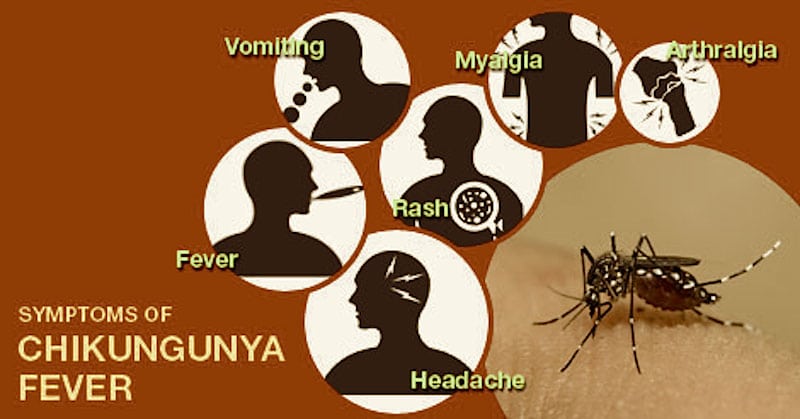

Chikungunya fever is a viral disease transmitted to humans by infected mosquitoes. It is characterized by fever, headache, rash, and severe joint and muscle pain. The name Chikungunya which Means: that which bends up”, is derived from the Kimakonde language of the Makonde people. This African tribute lives on the eastern border between Mozambique and Tanzania. Where Chikungunya virus was first detected in an epidemic that occurred in 1952-53, the disease was given its name because severe musculoskeletal pain caused affected persons to walk in a stooped posture.
Chikungunya (also called as Chicken Guinea) is a form of viral fever caused by an alphavirus that is spread by mosquito bites from the Aedes aegypti mosquito, though recent research by the Pasteur Institute in Paris claims the virus has suffered a mutation that enables it to be transmitted by Aedes Albopictus (Tiger mosquito). This was the cause of the actual plague in the Indian Ocean and a threat to the mediterranean coast at present.
Chikungunya – HOMEOPATHY TREATMENT & HOMEOPATHIC REMEDIES
Homeopathy is one of the most popular holistic systems of medicine. The selection of remedy is based upon the theory of individualization and symptoms similarity by using holistic approach. This is the only way through which a state of complete health can be regained by removing all the sign and symptoms from which the patient is suffering. The aim of homeopathy is not only to treat Chikungunya but to address its underlying cause and individual susceptibility. As far as therapeutic medication is concerned, several homeopathic medicine for chikungunya fever are available that can be selected on the basis of cause, sensations and modalities of the complaints. For individualized remedy selection and homeopathic medicine for chikungunya fever, the patient should consult a qualified homeopathic doctor in person. There are following remedies which are helpful in the treatment of Chikungunya:
Homeopathy offers many medicines which may help in Chikungunya. These include medicines like Eupatorium-perf, Pyroginum, Rhus-tox, Cedron, Influenzinum, China, Arnica, Belladona, Bryonia, Arsenic-album etc. Many homeopaths consider Eupatorium perf. as a preventive medicine for Chikungunya. The most commonly suggested potency as prophylaxis is 200C of Eupatorium perf. Eupatorium Perfoliatum Q (tincture, 3 to 5 drop dose) is said to remove the debilitating joint pains and cut short the intensity and duration of the disease. Other potencies may be used according to the intensity of the case. If prostration is very pronounced, Arsenic-album and China are to be given importance. If there is severe headache, China, Cedron and Belladonna should be considered. If headache and prostration are both found together, China is the remedy that is likely to help. Please consult a professional homeopath to find the most suitable remedy for a given case.
Common Homeopathy Remedies for Chikungunya Fever
- Eupatorium-perf
- Pyroginum
- Rhus-tox
- Cedron
- Influenzinum
- China
- Arnica
- Belladona
- Bryonia
- Arsenic-album
- Gelsemium
- Sulphur
- Bryonia
- Aconite nepllus
- Merc. sol
- Baptisia
- Carbo veg
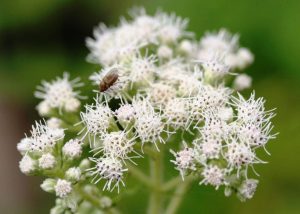
Eupatorium perfolatum
- Wonderful homeopathic medicine for chikungunya fever and all kind of joint and muscles pain developed with
 or after febrile disease.
 - Bone pains, general to severe. Soreness with marked periodicity of complaints.
- Aching all over the body and soreness of flesh.
- Swelling of joints.
- Intense headache with typical soreness of eyeball.
- Periodical headache.
- Thirst with fever.
 or after febrile disease.
Rhus toxicodendron
- Fever with urticaria, hives.
- Pain in joints fever with.
- Hot and painful joints with great physical restlessness.
- Patient incline to change posture continuously or stretch the limbs.
- Pain in joints aggravated during rest or by initial motion and ameliorated by continue motion.
- Pain in body on exposure of cold air.
China officinalis
- Intermittent fever with great periodicity.

- Intense headache during fever. Prostration both physically and mentally.
- Joints are swollen, very sensitive to touch and better by hard pressure.
- Debility and trembling of extremities.
Pyroginum
- Very good medicine for septic fevers where the temperature rises rapidly.
- Great heat with profuse sweat but sweating does not cause a fall in temperature.
- Aching in all limbs and bones.
- Bed feels too hard.
- Soreness all over the body better by motion.
Arnica Montana –
- Severe pain in extremities.
- Homeopathic medicine for chikungunya fever that has great fear of being touched or approached.
- Pain in extremities as if bruised o beaten.
- Everything on which he lies seems too hard.
- Sprained and dislocated feeling.
Arsenic album
- Septic fevers with high rise of temperature.
- Periodicity with mark prostration.
- Restlessness both mentally and physically.
- Useful in cases where joint pains are not so marked but patient is restless with great exhaustion.
Bryonia
- Homeopathic medicine for chikungunya fever it also act very nicely in many kind of fever.
- Thirst for large quantity of water at long interwals.
- Patient is very sensitive for least motion. Don’t want to move slightly.
- Slightest motion cause pain in body.
- Sits quietly do not talk and do not want to disturb.
Other medicines include Gelsemium, Sulphur, Aconite nepllus, Merc. sol, Baptisia, Carbo veg etc.
For complaints like Joint Pains remaining after Chikungunya Fever or Swelling in Feet/Ankles after Chikungunya Fever, consider the following remedies
generalities; swelling; edematous; fever; after (64)
generalities; convalescence, during; fever, after (23)
generalities; weakness; fever; after (43)
The one remedy that covers all of them is China, so China can be used as the remedy for the after effects of Chikungunya fever.
Dr. Bhatia found Sulphur 200 clinically most useful in large number of patients suffering from joint pains after fever, in 2016.
Our reader’s have shared that in most cases they have Eupatorium perf and Rhus tox affective for pains remaining after Chikungunya Fever. One reader suggested use of Kali mur 1M for joint pains remaining after Chikungunya fever.
Chikungunya – CAUSE
Chikungunya is transmitted through mosquitoes. The virus which is responsible for Chikungunya is known as Alphavirus, which is carried by the Ades Aegypti mosquito that breeds in stagnant water.
CHARACTERISTICS: Togaviridae (formerly group A arboviruses), genus Alphavirus; spherical, enveloped virions 60 nm in diameter, single-stranded, positive-sense RNA genome
EPIDEMIOLOGY: Found in Africa, India, south East Asia and the Philippines
HOST RANGE: Humans, primates, other mammals, birds
Chikungunya Symptoms
The primary symptoms of Chikungunya include –
- Fever which can reach 39°C, (102.2 °F)
- A petechial or maculopapular rash (red area on the skin that is covered with small confluent bumps) usually involving the limbs and trunk
- Arthralgia (bodyache) or arthritis (Inflammation of joint) affecting multiple joints which can be debilitating. The joint pains can be severe and even crippling.
- There can also be headache, conjunctival infection and slight photophobia (condition in which bright lights hurt the eyes).
- Fever typically lasts for two days and abruptly comes down, however joint pain, intense headache, loss of sleep and an extreme degree of prostration lasts for a variable period, usually for about 5 to 7 days.
Skin manifestations in Chikungunya fever
Many skin symptoms in Chikungunya fever are observed in a recent outbreak of Chikungunya fever in Southern India includes the following:
- Maculopapular rash
- Nasal blotchy erythema (Skin redness in patches due to increased blood flow or inflammation )
- Freckle-like pigmentation on face.
- Flagellate pigmentation ( The linear or streaked pigmentation) on face and extremities
- Hyperpigmentation in sunlight exposed areas
- Multiple aphthe-like ulcers over scrotum, crural areas and axilla.
- Localized fluid retention and swelling in that occurs on fingers, soles and limbs. (both side /one sided)
- Multiple blue green ecchymotic spots (Specially in children)
Chikungunya – HOW DIAGNOSIS IS DONE?
- Blood test for detection of causative organism and antibodies made against the organism to fight in blood.
- ELISA is available to detect antichikungunya immunoglobin IgM, and IgG antibodies
- An IgM capture ELISA is necessary to distinguish the disease from dengue fever.
- Isolation of virus – virus isolation test gives the most accurate results for Chikungunya.
- Reverse transcriptase-polymerase chain reaction (RT-PCR) – to detect RNA in acute phase of infection from serum of patient.
Chikungunya – CONVENTIONAL TREATMENT
No vaccine or specific antiviral treatment for chikungunya fever is available. Treatment is symptomatic–rest, fluids, and ibuprofen, naproxen, acetaminophen, or paracetamol may relieve symptoms of fever and aching. Aspirin should be avoided
Infected persons should be protected from further mosquito exposure (staying indoors and/or under a mosquito net during the first few days of illness) so that they can’t contribute to the transmission cycle.
For treatment of active condition, we have received suggestions about Polyporous Pinicola 200C.
For prevention, we have received suggestions for Eupatorium perf, Arsenic album, Polyporous Pinicola, Chikungunya nosode and PC remedies.
Chikungunya Fever Cases Cured with Homeopathic Medicine
A Case of Chikungunya Type Fever – by Suruchi Sodhani
Case Study: Teenager with Chikungunya Virus – by Beverley Brown

Dear sir/madam,
can anyone suggest me how to cure chikungunya,what is procedure, & where medicine is available in mumbai?address & telephone nos.if any.
For joint pain of chikungunya , what medicine in homeopathy needs to be taken. Please advise me. If you can give some contact numbers , then please do so.
There’s an article here on chikungunya here:
https://hpathy.com/cause-symptoms-treatment/chikungunya/
But my best advice is to have your case must be taken by an experienced homeopath. Contact the homeopathy organization in your country for a referral. You can find that information here: https://hpathy.com/homeopathy-organizations/
Thank you for posting this interesting article, Dr. Bhatia. What a dreadful disease. I’m glad I already have most of these remedies on hand, just in case.