

Prostate cancer is one of the most common types of cancer affecting men. Around 1.1 million prostate cancer cases were recorded in 2012, accounting for around 15 per cent of all new cancer cases in men. Prostate cancer usually occurs in the older men.
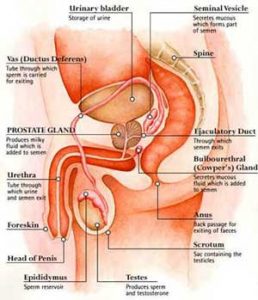 The prostate is a gland in the male reproductive system that produces the majority of the fluid that makes up the semen, the thick fluid that carries sperm.
The walnut-sized gland is located beneath a man’s bladder and surrounds the upper part of the urethra. The tube that carries urine from the bladder. Prostate function is regulated by testosterone, a male sex hormone produced mainly in the testicles.
Prostate cancer is a major health concern for American men. Although the disease is rare before age of 50, experts believe that most elderly men have at least traces of it.
More than 200,000 new cases and about 30,000 deaths are attributed to prostate cancer each year in the U.S. for reasons not fully understood; African- American men have the highest frequency of prostate cancer in the world and highest death rate from the disease. In other parts of the world – notably Asia, Africa and Latin America- prostate cancer is rare.
In India, it is the second most common cancer in Indian males as per the Indian Council of Medical Research (ICMR) and various state cancer registries. The incidence rate in India is 9-10/100000 population.
Prostate cancer cells do not follow the usual cancer growth patterns, which are to grow uncontrollably and spread to other tissues. Prostate cancer is typically a very slow growing tumor, often causing no symptoms until advanced stages. Most men with prostate cancer die of other causes, many without ever realizing that they have the disease. Prostate cancer in its early stage can be cured. Fortunately, about 85% of American men with prostate cancer are diagnosed in the early stages.
But once prostate cancer begins to grow more rapidly or spreads outside the prostate, it is dangerous. This aggressive type of prostate cancer can occur at any age. Although the disease tends to progress slowly, it is generally fatal if it spreads beyond the prostate gland itself.
Cancer that has spread beyond the prostate to distant tissues ( such as bones, lymph nodes and lungs) is not curable, but it often can be controlled for many years. Because of the many advances in available treatments, the majority of men whose prostate cancer becomes widespread can expect to live five years or more.
Causes of prostate cancer
- Advanced age
- Family history of prostate cancer
- Exposure to carcinogenic rays
- Exposure to certain chemicals
- Race – more common in Africans
- Dietary factors
- Sedentary lifestyle
- Risk factor – smoking
Sign and symptoms of enlarged prostate
- Getting up at night to urinate more often than one time per night
- Urinating more frequently than every two hours during the daytime
- Feeling that you have to urinate, but when you attempt to, finding that it takes a while for the urine to come out
- Straining or pushing to get your urine stream started and/ or to maintain your stream
- Dribbling urine near the completion of voiding
- A urine stream that stops and starts during voiding
- Feeling of incomplete emptying after voiding such that you feel that you could void again shortly.
Clinical features of prostate cancer
- Sometimes patient, who is being treated of BPH that is undergoing prostectomy reveals prostate cancer.
- Patient may present with multiple bone pains due to metastasis
- In rectal examination nodule is felt in anterior wall of rectum
- Acute retention of urine
- Difficulty in passing urine
- Pain during micturation
- Interrupted flow.
Other symptoms mainly include
- Weight loss
- Weakness
- Decreased appetite
- Pain in back or pelvic region
- Pain during ejaculation
- Hematuria
Screening and diagnostic test for prostate cancer
In an attempt to detect prostate cancer at its earliest stage, it is recommended that the digital rectal examination and prostate specific antigen (PSA) test be performed during routine annual examinations starting at the age of 5o. However, if there is a family history of prostate cancer or if the man is African-American, then annual testing should begin at age 45. Screening can also be performed in response to a patient exhibiting one or more of the symptoms mentioned previously.
1% of men suffer with prostate cancer that does not produce an elevated PSA level. Conversely, the PSA test may indicate the presence of the disease when it cannot be palpated.
It should be kept in mind that an elevated PSA level is not synonymous with prostate cancer. There are a number of conditions other than cancer that can result in this elevation.
For example, PSA level normally increases with age or with an enlarged prostate that is either the result of normal growth as a men ages (benign prostate hyperplasia) or due to infection or inflammation (prostatitis). It also increases for a day or two after ejaculation. It is also possible for certain prescribed medication (e.g., finasteride) and herbal supplements (e.g., Saw Palmetto) that are advertised for prostate health to decrease PSA levels, potentially masking any elevation that may occur in the PSA level.
A patient should notify his healthcare provider of all medications, vitamins, and dietary supplements being taken because they may have an effect on test results.
A Variety of the tests are available to determine the stage of the disease
The diagnosis of cancer by a prostate biopsy is typically followed up by one or more tests in order to stage the disease within the gland but also to determine whether it has spread to surrounding tissue. A localized stage of prostate cancer is confirmed to the prostate whereas a regional stage has spread to nearby tissues such as the seminal vesicles or bladder, but not to distant sites.
Prostate cancer has tendency to metastasize to the bones accounting for persistent pain and stiffness. A particular type of radionuclide bone scan can be used to locate areas in the skeleton that contain very active cells which may be sites where metastatic cancer cells reside. This procedure entails the injection of a small amount of low – level of radioactive material into the patient’s bloodstream that travels throughout the body. Cells that are very metabolically active, such as cancer cells, will take up more radioactive material than will less active cells.
It is possible with very detailed 2-D images or 3-D models created by MAGNATIC RESONANCE IMAGING, to distinguish between healthy and diseased tissue.
Benign hypertrophic and cancerous prostate cells produce a prostate – specific membrane glycoprotein (PSMG), which is a carbohydrate -linked protein locate only in cellular membranes of these types of cells. Normal prostate cells do not produce PSMG or produce very small quantities of it. During a prostataScint scan, a radioactive monoclonal antibody with a binding specificity for PSMG is injected in to the patient and a body scan is taken to detect where the radioactive antibody is located. A prostate scan is useful in determining the exact location of cancer cells within the prostate as well as in local lymph nodes or nearby tissues.
Treatment of Prostate Cancer
The optimal management remains controversial. Patient with the disease are usually offered surveillance as this disease is indolent. The treatment options for localized prostate cancer are radical prostatectomy, external beam irradiation, and watchful waiting. In general, the more aggressive the therapy the greater the chance of disease control and the greater the side effects. Treatment is individualized according to age, co-morbidity and personal preference.
Stage T3 patients are treated with external beam radiotherapy, androgen ablation therapy, or watchful waiting. Androgen ablation is the treatment of choice for metastatic disease.
Homeopathic treatment of prostate cancer
 Homeopathy is one of the most popular holistic systems of medicine. The selection of remedy is based upon the theory of individualization and symptoms similarity by using holistic approach.
This is the only way through which a state of complete health can be regained by removing all the sign and symptoms from which the patient is suffering.
The aim of homeopathy is not only to treat prostate cancer but to address its underlying cause and individual susceptibility. As far as therapeutic medication is concerned, several well-proved homeopathy remedies are available for prostate cancer symptoms treatment that can be selected on the basis of cause, condition, sensation, extension, location and modalities of the complaints.
For individualized remedy selection and treatment, the patient should consult a qualified homeopathic doctor in person. There are following homeopathic medicines which are helpful for the treatment of prostate cancer symptoms:
Crotalus horridus, Conium, Sabal serrulata, Lycopodium, Copaiva, Sulphur, Selenium, Silicea, Nitric acid, Thuja, Staphysagria, Schirrinum, Baryta iod, Cadmium flouoricum, Chimaphilla, Medorrhinum, Thymol, Cadmium phos, Sepia, Carcinocin, Ionising Radiation, Baryta carb and many other medicines.
Prostate Cancer Cases Cured with Homeopathic Medicine
Cancer of the Prostate in a Man of 74 – by Vitan Gosain
A Case of Prostate Cancer – with Bilateral Grade I Medical Renal Disease – by A.P. Sivakumaran





I believe you have a very informative overview for prostate cancer. It is easy to understand. From its meaning, signs, symptoms and treatments. Thanks for providing part of your knowledge about this disease in the Internet.
Thank You, An excellent article. I now have a patient who has advanced Prostate Cancer who has come to me. Every three months he has radioactive transplants inserted. A very advanced case. My task is to slow down the disease process and improve quality of life. If I am able to give him another year or two of life, this is probably the most I can achieve. The more I read of Cure by Homoeopathy, the more I am inspired to treat such advanced cases with confidence. Thank you so much for your very valuable website. May your site flourish. My sincere regards, Kenneth Eames.
pl. call me
My father is suffering from prostate cancer. he is 82 years old.
regards,
Bhadresh Limbachiya
I am referred for suspected prostate cancer. Could you please tell me where I can see Homeopathy doctors in Melbourne?
Dear Dr. Manish Bhatia,
I am 81,5 years old with a last time diagnose of “aggressive form of prostate cancer in the last place on Gleason scale (8). I have a big confidence in homeopathy because I was helped by Dr. Rajesh Shah from Bombay in the treatment of an extended neuro-dermatitis on my legs and also with a sustaining help treatment for Limphome in the least stadium (16 years ago) treated and cured with intensive classical cytostatisc therapy and helped also of Dr. Shah to diminish the secondary effects of the classical chemical treatment. Unfortunately is not longer permitted in Sweden to receive any medicines from countries not EU included so I had to interrupt my treatment with Dr. Shah many years ago.
I read your interesting articles on cancer of prostate and I wonder if you could treat me as a patient by correspondence, sending me the prescribed homeopathic medicines by recommended post (supposing that the the medicines will be sent from Greece or other EU country. Today I received the results of the investigations done by magnetic resonance, biopsy, syntigraphy and computer tomography. All the results are actual (the last 2 were done within a week before). If you could accept me as your patient and also send to me medicines I would be very lucky. Kindly send me the conditions of the treatment and all the necessary medical and practical questions. Thankfully, Sterian
I am 82 years and I got a diagnose of “aggressive form of prostate cancer – 8 on Gleason scale. Could you accept me as a patient and send me the homeopathic treatment by post from an EU country? Thank you for an answer.
I’m 71 and have had my prostate removed due to a high 10 Gleason test. My biopsy showed cancer in 1 of 4 lymph nodes. Now I have to decide on targeted radiation and chemotherapy.
My question is which one is the most beneficial in decreasing cancer, or is it better to do both if one can handle the combined side effects? Or do you recommend a different route to deal with this problem like homeopathic or others?
Please advise and thank you for your response!
Can I recommend going to http://www.ChrisBeatCancer.com as a place to start?