

Introduction
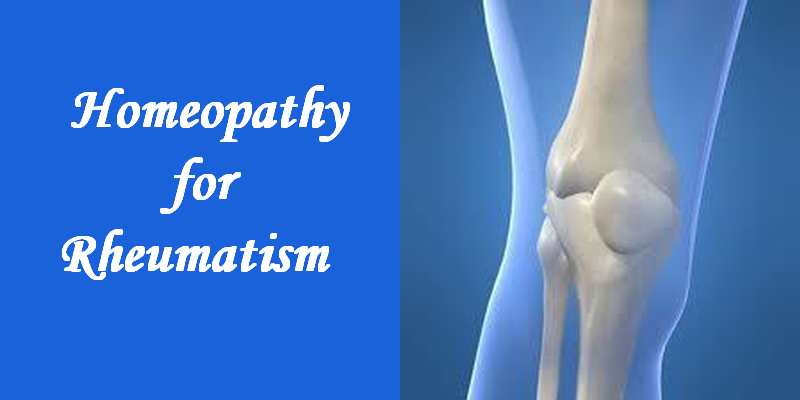
The word rheumatism is derived from the Greek word ‘rheuma’, which means a swelling. It refers to an acute or chronic illness which is characterized by pain and swelling of the muscles, ligaments and tendons, or the joints. The medical terminology for rheumatism arthritis is rheumatoid arthritis. Rheumatism arthritis is a chronic and painful disorder which can attack the joints on your arms and legs leaving them inflamed and swollen. Although rheumatism symptoms may often resemble those of another condition called osteoarthritis, one can spot a few differences between them. In rheumatism arthritis, the lining in the joints is inflamed while in osteoarthritis the painful condition is due to wear and tear of joints and ligaments. Left untreated, rheumatism arthritis would ultimately result in denuded bones and permanently distorted joints. Osteoarthritis, on the other hand, is a painful condition but may not cause any permanent damage.
Homeopathic treatment of Rheumatism
Homeopathy is one of the most popular holistic systems of medicine. The selection of remedy is based upon the theory of individualization and symptoms similarity by using holistic approach. This is the only way through which a state of complete health can be regained by removing all the sign and symptoms from which the patient is suffering. The aim of homeopathy is not only to treat rheumatism but to address its underlying cause and individual susceptibility. As far as therapeutic medication is concerned, several remedies are available to treat rheumatism that can be selected on the basis of cause, sensations and modalities of the complaints. For individualized remedy selection and treatment, the patient should consult a qualified homeopathic doctor in person. There are following remedies which are helpful in the treatment of rheumatism:
Colchicum – Although usually thought of in gout, Colchicum is no mean remedy in rheumatism.  It has a special affinity for fibrous tissues, tendons, aponeuroses, ligaments,and periosteum. It has also shifting rheumatism like Kalmia, Pulsatilla, etc., The pains are worse in the evening; the slightest motion aggravates; the patient is irritable; the pain seems unbearable. Sometimes it is useful when the rheumatism attacks the chest, with pains about the heart and a sensation as if the heart were squeezed by a tight bandage. There is great evening aggravation; the joints are swollen and dark red. Colchicum is especially useful for rheumatic affections in debilitated persons those who ares weak-weakness being the characteristic. It is a remedy too, for the smaller joints. asthenic subacute rheumatism in people overworked and subject to hygiene, with wavelike electric pains, traveling crosswise or from left to right. Special affinity for fibrous tissues.
Benzoic acid – arthritis deformans; painful nodes in joints, especially in syphilitic or gonorrhoeal patients, with rheumatic diathesis; pains go from right to left side and from below upward; aggravation from heat and joints cracking on motion; gout and rheumatism affecting heart or alternating one with other.
Lobelia – inflammatory rheumatism in right knee, swelling and extreme pain; painful stiffness in knees as after a long march; rheumatic pain between scapulae in right shoulder-joint, goes to the left upper arm and around the elbow-joint.
Ledum – Ledum is one of our best remedies for rheumatism ands gout, especially the latter. The great symptom which has always been regarded as the distinctive characteristic is the direction the pains takes, namely, going from below upwards. Like Caulophyllum and some others, Ledum seems to haves a predilection for the smaller joints. Nodes form in them and the pains travel up the limbs. The pains are made worse from the warmth of the bed. the effusion into the joints is scanty and it soon hardens and forms the nodosities above mentioned. Ledum, like Colchicum, causes acute, tearing pains in the joints; weakness of the limbs and numbness and coldness of the surface. Kalmia also has pains which travel upwards, but the character of the pains will distinguish. It may also be mentioned that Ledum is an excellent remedy in erythema nodosum, which is of rheumatic origin. Ledum produces and cures in certain cases an obstinate swelling of the feet. Wine aggravates all the symptoms of this drug. The characteristics of Ledum may be thus summed up: 1. Upward extension of the pains 2. Tendency to the formation of nodes in the small joints. 3. Aggravation ;by the warmth ;of the bed. 4. Aggravation by motion. It is useful, too, after the abuse of Colchicum in large doses.
Guaiacum – guaicum is a remedy with many rheumatic symptoms. It is in the chronic forms of articular rheumatism where the joints are distorted with concretions that it will do the most good.
Ranunculus B – great remedy for intercostal rheumatism.
Apis Mel – acute inflammatory rheumatism, mostly articular; affected parts feeling very stiff and exceedingly sore to any pressure, often with sensation of numbness; sensation as if the swollen joints were stretched tightly.
Silicea – is a remedy thought of in treating hereditary rheumatism. The pains are worse at night; worse from uncovering, better from warmth.
Kalmia – Kalmia is another of the remedies which have wandering rheumatic pains, and it is especially useful in rheumatism affecting the chest, or when rheumatism or gout shifts from the joints to the heart, driven there perhaps by external applications. It also has tearing pains in the legs, without swelling, without fever, but with great weakness, and in this symptom of weakness it resembles colchicum. The pains about the chest in Kalmia cases shoot down into the stomach and abdomen. The muscles of the neck are sore and the back is lames. Hering says that the rheumatism of Kalmia “generally goes from the upper to the lower parts,” while Farrington says, “the Kalmia rheumatism, like that of Ledum, almost always travels upwards.” At any rate, the rheumatic pains are mostly in the upper parts of the arms and lower parts of the legs; and are worse when going to sleep. Inflammatory rheumatism, shifting from joint to joint, with tendency to attack the heart, high fever, excruciating pains, which, of course, are made worse by motion, will be benefited by Kalmia. In valvular deposits Kalmia and Lithium carbonicum are our foremost drugs. especially useful when gout or rheumatism, after external applications, shifts from joints to heart; sharp severe pain about heart; pericarditis rheumatic, first stage, with rapid visible beating of the heart.
Arnica Montana – rheumatism resulting from exposure to dampness, cold and excessive muscular strain combined. Soreness and bruised of parts. Rheumatism of the intercostals muscles.
Bryonia Alba – The rheumatism of Bryonia attacks the joints themselves, producing articular rheumatism, and it also inflames the muscle tissue, causing muscular rheumatism. The muscles are sores and swollen, and the joints are violently inflamed, red, swollen, shiny, and very hot. The pains are sharp,stitching or cutting in character, and the great feature of the drug should always be present, namely the aggravation from the slightest motion. Touch and pressure also aggravate. There is but little tendency for the rheumatism of Bryonia to shift about like that of Pulsatilla or Kalmia. It is not liable to be mistaken for any other remedy. Ledum has some points of similarity. It would come in in articular rheumatism, where there is a scanty effusion, while Bryonia tends to copious exudation.
Tarantula – rheumatism checked by putting extremities in cold water, followed by panting respiration, anxiety, cramps or twisting pains in heart.
Nux Vomica – rheumatism in back, patient unable to turn over in bed without first sitting up; pains aggravate at night when lying on bed.
Nux Mos – rheumatism after getting feet wet.
Calcaria Carb – rheumatic affections caused by working in water will call for Calcaria Carb.
Mercurius – rheumatic pains worse at night.
Caulphyllum – rheumatism of the metacarpal and phalengeal articulations of the hand.
Phytolacca – The sphere of Phytolacca seems to be where there is a syphilitic taint. It is particularly useful in pains below the elbows and knees. There is stiffness and lameness of the muscles; the pains seem to fly about, are worse at night and are especially aggravated by damp weather. Rheumatic affections of the sheaths ;of the nerves; periosteal rheumatism or rheumatism of the fibrous tissues often is benefited by Phytolacca. Rheumatism of the shoulder and arms, especially in syphilitic cases, may call for this remedy. It cured a case of right deltoid rheumatism of twenty-seven years’standing.
Sangunaria can – Sanguinaria inflames muscular tissue, giving a picture of acute muscular rheumatism. The muscles are sore and stiff, with flying erratic pains in them or stitching. The muscles of the back and neck are especially affected by it. The chief field of usefulness of the remedy seems to be in rheumatism affecting the right deltoid muscle. It is described as a rheumatic pain in the right arm and shoulder, worse at night or on turning in bed. It is so severe that the patient cannot raise the arm.
Risk factors of Rheumatism
- Female sex
- Frequent nasopharyngeal infections
- Poor housing and occupational conditions
- Negatively affect outcomes of primary Rheumatic fever and contribute to emergence of valvular disease. The initial attack of activity I or III degree, pronounced carditis, active rheumatic process at discharge, recurrences, absence of year-round prophylaxis allow prognostication of valvular heart disease.
Types of Rheumatism
The major rheumatic disorders currently recognized include:
- Ankylosing spondylitis
- Back pain
- Bursitis/Tendinitis, Shoulder pain, wrist, biceps, leg, knee (patellar), ankle, hip, and Achilles
- Capsulitis
- Neck pain
- Osteoarthritis
- Psoriatic arthritis
- Rheumatic fever
- Rheumatic heart disease (a long-term complication of Rheumatic fever)
- Rheumatoid arthritis
- Systemic lupus erythematosus
- Temporal arteritis and Polymyalgia rheumatica
- Myositis.
Sign and symptoms of Rheumatism
Early rheumatism symptoms may include persistent pain in the joints along with swelling.
• Apart from pain and swelling, if your joints are tender to the touch, you may suffer from rheumatism arthritis.
• Individuals suffering from rheumatism arthritis may also experience persistent fevers and chills.
• Fever may be accompanied by a feeling of fatigue.
• Swollen hands that are burning red and hot to the touch are another indication of rheumatism arthritis.
• Individuals suffering from rheumatism arthritis may find prolongated symptoms of morning soreness in their limbs.
• Some individuals may also notice a nodule like growth underneath the skin on their arms.
• Rapid weight loss is also a common symptom of rheumatoid arthritis.
Investigations of Rheumatism
- Blood test
Full blood count:
Anaemia may be due to chronic disease or blood loss from gastric irritation secondary to NSAIDs.
White cells: possible changes include neutrophilia in septic arthritis, eosinophiliain polyarteritisnodosa, neutropenia in Felty’s syndrome and leucopenia in SLE.
Platelets may be increased in rheumatoid arthritis and may be decreased in SLE.
Acute phase proteins:
- ESR and CRP are non-specific indicators of inflammatory activity.
- Uric acid: may be raised in gout.
Renal function:
May be renal dysfunction in chronic disease such as gout or connective tissue disorders.
- AUTOANTIBODIES: RHEUMATOID FACTOR
May support the diagnosis of rheumatoid arthritis. An antibody to a substance called cyclic citrullinated peptide (CCP) has been found to be more specific than rheumatoid factor in rheumatoid arthritis and may be more sensitive in erosive disease.
- Antinuclear antibodies may suggest systemic lupus erythematosus or other connective tissue disorders.
- HLA B27: increased positivity in ankylosing spondylitis and other spondyloarthropathies.
- Serology, e.g. HIV, may be appropriate
- Other investigations
- Urine:
proteinuriamay be due to nephrotic syndrome associated with connective tissue disease.
- Synovial fluid:
- White cell count raised in infection.
- Gram stain (tuberculosis), culture and sensitivities.
- Crystal identification: urate, calcium pyrophosphate.
- Imaging:
- X-rays: may show distinctive changes, such as in rheumatoid arthritis, osteoarthritis. Chest x-ray may be indicated for lung involvement in rheumatoid arthritis, SLE, vasculitis and tuberculosis.
- Ultrasound: soft tissue abnormalities, e.g. synovial cysts.
- CT scan, MRI: much greater information of bone, joint and soft tissue.
- Arthroscopy:
- Direct view of joint and synovial fluid.
- Potential for biopsy and therapeutic procedures.
Rheumatism Cases Cured with Homeopathic Medicine
Chronic Articular Rheumatism – by Frankfort Strohmeyer
A Case of Rheumatism in a Woman of 68 – by Ajay Pandey
Case 3 from Sarajevo – by Lucinda Torabi
Two Cases (Male Infertility and Chronic Rheumatism) from Petr Zacharias – by Petr Zacharias