


Are you looking for a homeopathic cure for toothache? This article discusses the homeopathy treatment of toothache along with the best homeopathic medicine for toothache treatment.
A toothache, also known as odontalgia is an aching pain in teeth or the supporting structures of teeth caused by dental diseases or pain referred to the teeth by non-dental disease.
- In most cases toothaches are caused by problems in the tooth or jaw, such as cavities, gum disease, the emergence of wisdom teeth, a marginally cracked tooth, infected dental pulp, jaw disease, or exposed tooth root.
- Causes of a toothache may also be a symptom of diseases of the heart, such as angina or a myocardial infarction, due to referred pain.
- The severity of a toothache can range from a mild discomfort to excruciating pain (more common in the second molars, esp on the left mandible), which can be experienced either chronically or sporadically.
- This pain can often be aggravated somewhat by chewing or by hot or cold temperature. Toothaches are sometimes caused by an irritation of the pulp, known as pulpitis. This can be either reversible or irreversible.
- Irreversible pulpitis can be identified by sensitivity and pain lasting longer than fifteen seconds, although an exception to this may exist if the tooth has been recently operated on.
- Teeth affected by irreversible pulpitis will need either a root canal or an extraction.
Causes of Tooth pain
- Dentin hypersensitivity is a sharp, short-lasting dental pain occurring in about 15% of the population, which is triggered by cold (such as liquids or air), sweet or spicy foods, and beverages
- Pulpitis (inflammation of the pulp) can be triggered by various stimuli (insults), including mechanical, thermal, chemical, and bacterial irritants.
- Gingivitis – inflammation of the gums associated with pain swelling, bleeding and foul smell from breath.
- Dental carries – tooth pain due to cavity in the tooth which is also caused due to poor oral hygiene.Dental caries, also known as tooth decay or cavity, is a disease wherein bacterial processes damage hard tooth structure (enamel, dentin, and cementum). These tissues progressively break down, producing dental caries (cavities, holes in the teeth). Two groups of bacteria are responsible for initiating caries: Streptococcus mutans and Lactobacillus. If left untreated, the disease can lead to pain, tooth loss, infection, and, in severe cases, death.Tooth decay is caused by specific types of acid-producing bacteria that cause damage in the presence of fermentable carbohydrates such as sucrose, fructose, and glucose. The mineral content of teeth is sensitive to increases in acidity from the production of lactic acid.
- Jaw pain (Homeopathy for Jaw Pain) – caused due to various medical conditions like injury, neuralgia causes tooth pain.
- Grinding of teeth – especially children have this habit to grind teeth which can cause tooth pain.
- Food impaction occurs when food debris, especially fibrous food such as meat, becomes trapped between two teeth and is pushed into the gums during chewing
- Infant teething troubles – causes tooth pain along with irritation and other associated symptoms.
- Tooth abscess – A tooth abscess or root abscess is pus enclosed in the tissues of the jaw bone at the tip of an
 infected tooth. Usually the abscess originates from a bacterial infection that has accumulated in the soft pulp of the tooth. Abscesses typically originate from dead pulp tissue, usually caused by untreated tooth decay, cracked teeth or extensive periodontal disease. A failed root canal treatment may also create a similar abscess. It may also develop from bacteria entering a tooth filling and multiplying. A pus taste may also develop.
There are three types of dental abscess. A gingival abscess that involves only the gum tissue, without affecting either the tooth or the periodontal ligament. A periapical abscess starts in the dental pulp. A periodontal abscess begins in the supporting bone and tissue structures of the teeth. A periodontal abscess (lateral abscess) is a collection of pus that forms in the gingival crevices, usually as a result of chronic periodontitis where the pockets are pathologically deepened greater than 3mm. - Infection in the ear – pain often extends to tooth which is aggravated by chewing and swelling.
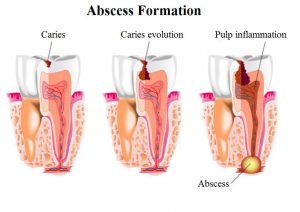 infected tooth. Usually the abscess originates from a bacterial infection that has accumulated in the soft pulp of the tooth. Abscesses typically originate from dead pulp tissue, usually caused by untreated tooth decay, cracked teeth or extensive periodontal disease. A failed root canal treatment may also create a similar abscess. It may also develop from bacteria entering a tooth filling and multiplying. A pus taste may also develop.
Homeopathy for Toothache
Homeopathy has wonderful action on various conditions that are responsible for toothache. Like Dentin hypersensitivity, pulpitis, dental abscess, infant tooth problems etc. In other medical condition like dental caries medicine can temporarily relieve your symptoms of pain but other aids like root canal or an extraction are recommonded for permamant relief.
Homeopathy treats the person as a whole. It means that homeopathic treatment focuses on the patient as a person, as well as his pathological condition. The homeopathic remedies for toothache are selected after a full individualizing examination and case-analysis, which includes the medical history of the patient, physical and mental constitution etc. A miasmatic tendency (predisposition/susceptibility) is also often taken into account for the treatment of chronic conditions. The homeopathic remedies for toothache given below indicate the therapeutic affinity but this is not a complete and definite guide to the treatment of this condition. The symptoms listed against each remedy may not be directly related to this disease because in homeopathy general symptoms and constitutional indications are also taken into account for selecting a remedy. To study any of the following remedies in more detail, please visit our Materia Medica section. None of these homeopathic remedies for toothache should be taken without professional advice.
Following is the list of some common used homeopathic remedies for toothache
Calcarea flour, Silicea, Plantago, Mercurius, Coffea, Belladonna, Chamomilla, Staphysagria, Calcarea phos, Kreosote etc.
Details of homeopathic remedies for toothache
Mercurius
Taken all in all, Mercurius is probably more often indicated homeopathic remedy for toothache than any other remedy. Its special indications are a pulsating toothache, due to inflamed dentine or to periostitis of the sockets; it is worse at night and in damp weather. The teeth feel elongated and sore, and this soreness affects the whole of the jaw and face, and is worse from warmth, somewhat relieved by gentle rubbing of the face. It is the chief remedy in painful ulcerations at the roots of the teeth and for pain in the hollow teeth, the gums are swollen, ulcerated and retracted from the teeth, and there is usually an offensive odor from the mouth.
Chamomilla
This is an excellent homeopathy remedy for toothache especially in unbearable toothache affecting a whole row of  teeth occurring in paroxysms, with pains radiating to the ears. The special features are the intolerance of pain, aggravation, from warmth. It is worse during and after eating warm food, and especially from drinking coffee.
Belladonna
Has toothache from inflammation of dental pulp. The pains are burning and throbbing, worse at night, worse on contact, as in chewing and in the open air. There is a red hot face and great nervous excitability.
Coffea
This homeopathic remedy will often remove the most severe pains of toothache which almost drive the patient frantic. It is a stinging, jerking, intermittent pain, worse while chewing, worse from warm drink, and entirely relieved for a time by holding cold water in the mouth, returning when the water becomes warm. It suits especially hypersensitive, nervous persons.
Plantago major
Hale says that of all homeopathic remedies for toothache, none can compare with Plantago, and Hughes supports  this statement. The teeth feel elongated and sore and sensitive to touch, with swollen cheeks. The pains are periodic, easily excited, even affecting sound teeth; they are worse lying on the affected side, and sometimes these stabbing and boring pains become very severe.
Silicea
This remedy suits especially abscesses about the roots of the teeth and dental fistulae; the pains are worse from eating warm food or or when cold air gets into the mouth; they are worse at night and the teeth feel loose.
Calcarea fluorica
This homeopathic remedy produces a roughness of the teeth a decay of the enamel. Dr. R. S. Copeland claims to have produced this condition of the decay of the enamel in a patient for whom he prescribed the remedy for catarrh. It is useful in flaking off of the enamel and deficiency of same.
Calcarea phosphorica
With this remedy there is slow development, and rapid decay of the teeth. It suits dental troubles in flabby, emaciated children who open posterior fontanelles, and are slow in learning to walk.
Magnesia carbonica is especially useful in toothache or pregnancy, and Dr. Leavitt mentions Sepia as almost specific in this condition.
Staphisagria
With this homeopathic remedy the gums are unhealthy and retracted, and there is a tendency to decay of the teeth. They turn black and crumble as soon as they appear, a condition found in sycotic children. It is a splendid remedy for gnawing in the roots of decayed teeth, affecting a whole row, and is especially adapted to old women who have a mouthful of painful stumps.
Kreosote
This remedy has premature decay of milk teeth; they become yellow, and dark and then decay. It also has aching pains in diseased teeth. Terebinthina is here complementary especially it the mouth be sore.
Spigelia
This is an excellent homeopathic remedy for toothache, especially in tearing, beating pains in carious teeth extending to the malar bone of the affected side. Painful jerks in decayed teeth worse from cold or cold water. The pains set in after eating, smoking or retiring to test, driving the patient from bed their severity. The provings of Spigelia show that it has a remarkable influence over the nerves of th face, jaws and teeth.
Arnica
This is a very useful remedy for bleeding after extraction of teeth, and for pain and swelling from wearing false teeth, or pains produced by filing or filling or excavating teeth. The sensation is one of soreness.
Homeopathic remedies for toothache offer quick pain relief. Find best homeopathy remedy for tooth pain and homeopathy for toothache relief.
Toothache Case Cured with Homeopathic Medicine
A Toothache in Three Parts – Elaine Lewis
Case: Male, 58, toothache – by Diderik Finne
A Case of Violent Abdominal Spasms – by George Heinrich Gottlieb Jahr



good social information, keep the good work going great.
good work
There is no better remedy for abscessed teeth than Pyrogennum… I use to have difficulty with teeth abscessing…weak roots… once I discovered Pyrogennum I’ve never ever had an abscessed tooth – over 10 yrs… If I feel a tooth heading in that direction I just take Pyrogennum 9x -30x a feXw times and its gone…
Hi Dr Sharma,
Do you know of any specific remedies for dentin hypersensitivity, worse for cold and sweet foods?
Regards,
Luis Miguel Trapaga
Great Article but now im more confuse than before. Which of all these should i be taking if i have Pulpitis. Teeh is fine but is very sensitive if i try to chew on that side or to the touch if i were to press it with my fingers. Used to have amalgam filling and just got them removed.
Thank you for such an informative post. When you say Mercurius — which type are you referring to? Mercurius Vivus, Mercurius Sulph Ruber, Mercurius solubilis etc.